

Borrowing Bonhoeffer
The cost of discipleship when everybody wants Dietrich over for tea


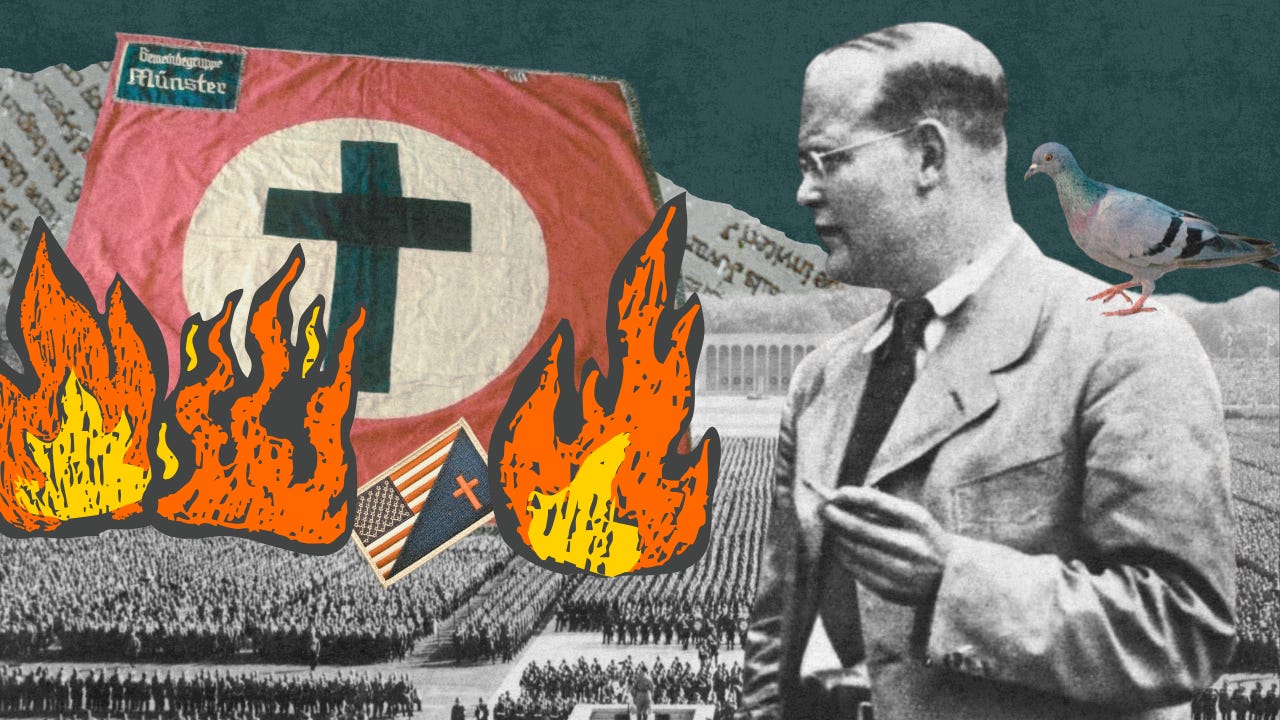
Dietrich Bonhoeffer has been following me around this week.
It’s possible this is the Holy Spirit attempting to guide my writing life. Buuuuuutttt…it’s also possible I am online too much, which is less flattering but probably has more supporting evidence. Either way, Bonhoeffer is everywhere again, at least in the algorithms Meta curates for me.
After the attempted assassination of President Donald Trump at the White House Correspondents’ Dinner, Bonhoeffer’s name started appearing almost immediately. While stress-eating extra garlic dill pickles (excellent for both pregnancy and the collapse of democracy), I happened upon half a dozen conversations discussing the actions and manifesto of Cole Thomas Allen alongside Bonhoeffer’s participation in the July 20th assassination plot against Adolf Hitler.
It is easy to at least empathize with those who attempted to kill the 20th Century's most notorious villain. If Trump represents a genuine authoritarian threat, does that make violence against him morally justifiable?
These are understandable questions to ask and links to make. We are a people of story, and we look for patterns. Scripture gives us images. History gives us warnings. Saints give us company. Martyrs give us courage.
Wilderness Times is built out of links between then and now, scripture and headlines. I believe in links. They help us to keep things in perspective.
But sometimes we reach for the saints and the martyrs because we want some cover.
This is why all the talk about Bonhoeffer is making me pause. It’s not that Bonhoeffer is irrelevant. Quite the opposite. He is almost too relevant, and that makes him easy to mishandle. He has the dangerous quality of someone whose life can be made to say just about anything we need it to, while ignoring the parts that counter our preferred narrative.

Dietrich Bonhoeffer was a Lutheran pastor and theologian.
He resisted the Nazi takeover of Christian churches in Germany and helped to found the Confessing Church. He was deeply opposed to the Deutsche Christen movement to rebrand Christian theology within Nazi ideology.
Bonhoeffer was arrested in 1943 for his role in helping Jews escape to Switzerland. During his incarceration, he became implicated in the wider resistance network connected to the July 20th plot. You might remember the dramatization of this story, with Tom Cruise in the role of Claus von Stauffenberg, from the 2008 film Valkyrie.
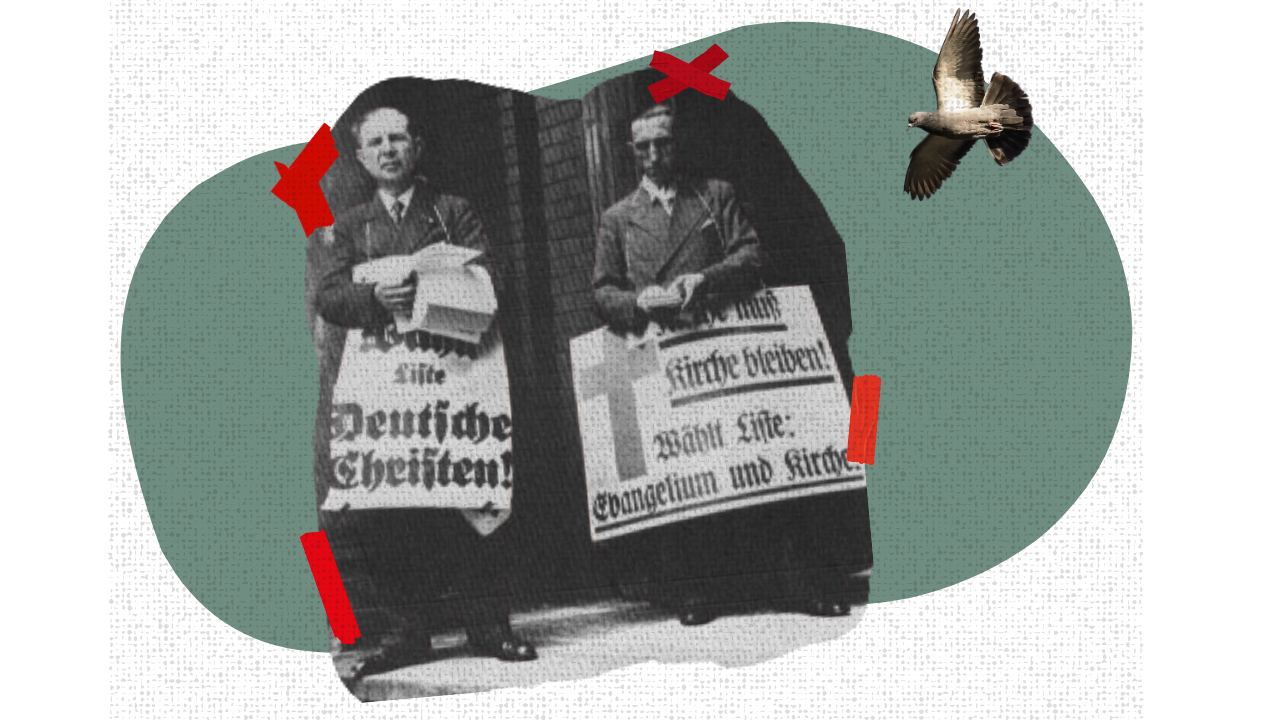
Bonhoeffer was executed on April 9, 1945, just weeks before the end of the war in Europe.
That is the Cole’s Notes version of the story many of us know.
It is a story just made for public myth…and cinema.
Angel Studios recently distributed a film titled Bonhoeffer: Pastor. Spy. Assassin. I watched it so you don’t have to (you’re welcome). For context, Angel Studios produced the first few seasons of The Chosen. They also produce Tuttle Twins, a series that teaches children the economic values of libertarian capitalism. They have a computer-animated adaptation of Animal Farm coming out this year. Based on the trailer, I am 97.6% certain it will be the topic of an upcoming article.
But back to Bonhoeffer…
Bad movies happen. Rocky IV is terrible, one of my favourite films, and definitely not a reliable source for anybody wishing to learn about the fall of the Iron Curtain. Angel Studios’ Bonhoeffer holds about the same level of historical accuracy, but without owning any of the camp.
This particular bad movie distorts Bonhoeffer’s legacy into something the International Bonhoeffer Society has explicitly warned against—a justification for Christian nationalism and political violence.
Just look at this poster. Bonhoeffer, handsome and brooding, holding a gun. He looks less like a theologian wrestling before God and more like Bruce Willis in Die Hard.1
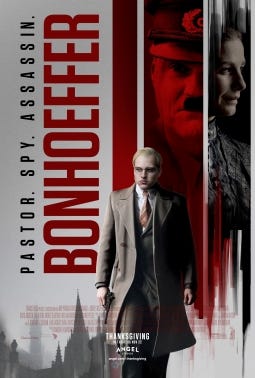
This film does little to represent the man who spent his life thinking about discipleship, community, confession, obedience, grace in both its cheap and costly forms, the Sermon on the Mount, the Church, and the hiddenness of God.2
We are horrified to see how the legacy of Dietrich Bonhoeffer is increasingly being distorted and misused by right-wing extremists, xenophobes, and religious agitators. As direct descendants of the seven siblings of the theologian and resistance fighter executed by the Nazis, we can testify based on what we learned from our families that he was a peace-loving, freedom-loving humanitarian. Never would he have seen himself associated with far-right, violent movements such as Christian Nationalists and others who are trying to appropriate him today. On the contrary, he would have strongly and loudly condemned these attitudes.
Descendants of the Bonhoeffer Siblings

It would be easier if the co-opting of Bonhoeffer’s life and work were only a problem among people I already distrust.
But Bonhoeffer is being claimed all over the place. Christian nationalists claim him as a symbol of resistance to tyrannical “woke” culture. Anti-fascists claim him as a symbol of necessary confrontation. Progressives claim him as a warning against authoritarianism. Evangelical politicians claim him when they wish to sound braver than their voting records.
Everyone wants Bonhoeffer over for tea.
He gives righteous justification to whatever we are already tempted to believe. Kinda like the Bible.
What is undeniable is that Bonhoeffer was an agent of resistance, and the question of resistance is terribly serious. We are living in a moment when democratic norms are being tested, threatened, mocked, and, in many places, torn into pieces. We are also witnessing pieces of the Church being complicit in the tearing.
I know that you know this.
So people reach for 1930s/40s Germany to make sense of what is happening now, and I understand why.3
But if we’re not careful, comparisons can also become alibis. And Bonhoeffer is one of the easiest alibis to borrow because his story, as it is so often told, contains what we secretly want from history: a moment when violence, perpetrated against those we experience as the enemy, appears to have a moral justification.
More on Broadview:
Bonhoeffer knew his participation in the resistance, whatever the goal, did not absolve him of guilt. He believed that one might be required to enter guilt on behalf of the neighbour and throw oneself on the mercy of God.
That is a confession rather than a manifesto.
Especially given the current news cycle, this is an important distinction. A manifesto is written to justify the self. A confession is spoken because the self will be judged. A manifesto gathers evidence for one’s own righteousness. A confession asks for mercy.
Bonhoeffer is tempting to lift up because he makes us feel virtuous. We can say “resistance” with theological conviction and imagine ourselves standing in a lineage of costly moral courage.
And perhaps some of us are doing exactly that.
Bonhoeffer believed the church could not remain neutral while the state crushed the powerless (spoke in the wheel, and all that). Christian faithfulness cannot simply be reduced to private virtue. Christ’s body may need to sacrifice itself to protect the oppressed.
But there is a moral cost in choosing violence, no matter the reason.

I think Bonhoeffer’s theological thought is overshadowed by the drama of his death because his execution gives us a story we can understand.
He resisted evil and was killed by evil. Kinda sounds familiar, yes? It’s a Christlike story, or close enough to one, that we think we know what to do with it.
But Bonhoeffer’s theology demands something more of us than admiration. His work asks us to consider how discipleship survives when obedience to Christ requires disobedience, not only to the state but also to what a culture of individualism values. What is the cost of grace? What does guilt mean? Are we willing to be part of a community that could demand everything of us?
Whatever Bonhoeffer’s witness has to say to this moment, it is not that violence becomes faithful once we have named the right enemy.
We have a burden to resist evil without becoming enchanted by our own resistance, and to protect the neighbour without worshipping ourselves as protectors. To act when action is required and still confess that even our necessary acts may need mercy. A burden to refuse cheap grace, cheap courage, cheap history, cheap comparisons, and cheap absolution.
I’m pretty sure Bonhoeffer would have understood our horror and rage at the rise of Christian Nationalism across North America. He’d get it.
But I wonder if Bonhoeffer would ask us to consider more honestly the cost of moral injury and the fracture violence leaves behind, even when we convince ourselves it might be justified. 🐦
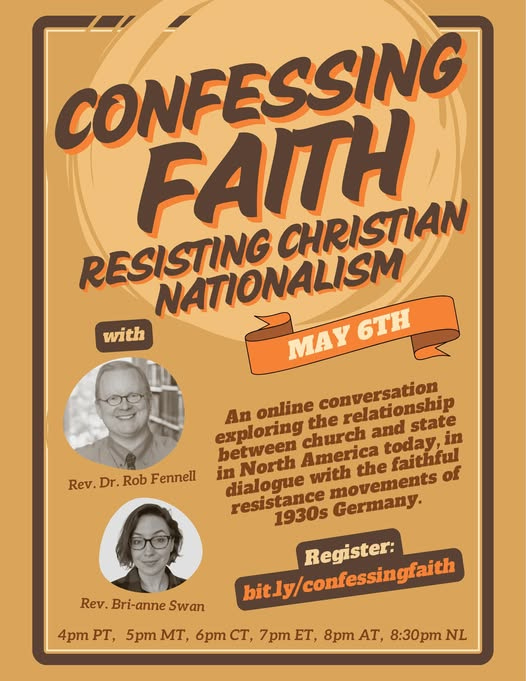
If you would like to be part of a conversation about Christian Nationalism as it exists today and how it relates to the resistance movements of 1930s Germany, the Rev. Dr. Rob Fennell and I would love to invite you to a free, online webinar happening on Wednesday, May 6th.
Wilderness Times is co-created with Broadview, an award-winning Canadian publication known for thoughtful journalism that attends to spirituality, justice and the questions that tug at our collective conscience.
Broadview is a registered charity and has made this Substack freely available because we believe that thoughtful, justice-seeking journalism should be accessible to everyone. Creating this space — and keeping it free — takes time, skill and resources. If this space nourishes you, please make a tax-deductible donation.
Your support empowers Broadview to tell more courageous stories and helps build a more just and compassionate world.
join me in the comments…
How do we tell the difference between faithful resistance and being enchanted by our own righteousness?
Who are the figures we most often turn into symbols instead of listening to as complicated witnesses?

By the way, if Die Hard is a Christmas movie, then Rocky IV is definitely a Christmas movie too.
For a much better film about Dietrich Bonhoeffer’s life, I recommend the Canadian/German coproduction Bonhoeffer: Agent of Grace (2000). Canadian viewers will likely recognize R.H. Thompson and Robert Joy in supporting roles.
But also…
Pastor. Spy. Assassin. was released immediately after the 2024 U.S. election. The version of Bonhoeffer depicted in the film is heavily based on Eric Metaxas’s 2010 biography Bonhoeffer: Pastor, Martyr, Prophet, Spy. Metaxas is a conservative radio host and fervent Trump supporter. He has made multiple comparisons between the Biden Administration and Nazi Germany.
Much as I would like to see Trump gone, there is no way I can condone violence. Jesus taught us to love one another. We also don't know what God's plan might be. I find it grossly unfortunate that the US government doesn't have control of its President.